Roast Beef & Yorkshire Pudding
| Active time | About 45 minutes, spread across the roast |
| Hands-off | ~2 hours (tempering, roasting, resting) |
| Difficulty | Moderate — the difficulty is the timing, not the technique |
| Key techniques | Dry brine; blast-then-moderate roasting; carryover heat; steam-leavened Yorkshire |
| Make-ahead | Batter up to 24 hours ahead; gravy base 1 day ahead |
| Reference | [Sunday roast timing](../../../techniques/sunday-roast-timing.md) |
Quantities live in the recipe card.
The beef
the whole meal hangs on this joint.
The Yorkshire pudding
equal parts egg, flour, milk by weight, rested.
The gravy
built in the roasting tin, where the flavor lives.
Doneness & Quality Checkpoints
- Beef internal: pull at 48 °C (118 °F) for rare, 50–52 °C (122–126 °F)
- Crust: deep mahogany, dry to the touch before roasting, audibly crisp
- Rest: 30–40 minutes minimum; the carving board collects juices, not a
- Yorkshires: towering, dark golden, hollow-centered, walls audibly crisp.
- Gravy: coats the back of a spoon (the nape test) and is seasoned last,
Roast Beef & Yorkshire Pudding
Prep: 30 minutes (plus tempering and batter rest) · Cook: 1 hour 45 minutes · Total: About 3 hours from fridge to table · 6
Ingredients
The beef
- 2 kg (4 lb 6 oz) bone-in sirloin or rib roast, 3 ribs (dry-aged if your butcher offers it)
- 15 g (1 tbsp) flaky sea salt
- 1 tsp cracked black pepper (3 g)
- 30 ml (2 tbsp) neutral oil
- 2 onions, halved (they roast alongside and seed the gravy)
The Yorkshire pudding
- 3 large eggs (150 g)
- 150 g (1 cup plus 2 tbsp) plain flour
- 150 ml (⅔ cup) whole milk
- ½ tsp fine salt (3 g)
- 45 ml / 40 g (3 tbsp) beef dripping from the roast (or sunflower oil)
The gravy
- All the roasting juices and roasted onions from the beef tin
- 30 g (¼ cup) plain flour
- 500 ml (2 cups) hot beef stock
- 100 ml (scant ½ cup) dry red wine, or more stock
- 1 tsp Dijon mustard (5 g), optional
- Sea salt and black pepper
Instructions
- Temper the beef. Two hours before roasting, take the joint out of the fridge, set it on a rack, and let it come to cool room temperature. Cold meat seizes in the oven and cooks unevenly — the outside overdone before the center wakes up.
- Dry brine. One hour before, rub the salt all over the beef and leave it uncovered. The salt draws moisture to the surface, dissolves, and is reabsorbed — seasoned to the middle, and a drier surface that browns harder. before it goes in. Checkpoint — the surface looks and feels dry to a fingertip just
- Make the batter. Whisk the eggs, milk, flour, and salt until smooth and the thickness of single cream — about a minute, no more. Rest it at least 30 minutes so the flour fully hydrates and the gluten relaxes; rested batter climbs higher. Checkpoint — smooth, thin, pourable, with no flour strands.
- Blast the roast. Pat the beef dry, rub with the oil and pepper, and set it on the rack in the roasting tin. Roast at 240 °C (465 °F) for 20 minutes to set the crust. quietly; the kitchen smells nutty, not smoky. Checkpoint — the fat edge is golden and the drippings sizzle
- Moderate the roast. Drop the oven to 180 °C (350 °F), scatter the onion halves around the joint, and continue roasting about 12 minutes per 500 g (per pound) — 65–75 minutes total after the blast for this joint. Rotate the tin once. Probe the thickest part of the muscle, not near a bone. Press the meat: it should spring back like the flesh of your cheek, not feel firm like your forehead. Checkpoint — 50–52 °C (122–126 °F) on the probe for medium-rare.
- Rest — the most important step. Transfer the beef to a warm plate or rack, drape foil *loosely* over it, and throw a tea towel on top. Rest 30–40 minutes. Carryover heat pushes the center up another 4–5 °C (8–10 °F) while the juices redistribute. Crank the oven to 230 °C (445 °F) the moment the beef is out. of red. Checkpoint — when carved, the board shows pink juice, not a flood
- Yorkshire puddings. Put 1 tsp of beef dripping in each pudding cup and slide the tin into the 230 °C (445 °F) oven for 5–8 minutes, until the fat is shimmering and just smoking. Give the rested batter a quick stir, pour into the cups two-thirds full, and bake 22–25 minutes **without opening the door** — a 20 °C drop mid-climb collapses the rise. hollow, dimpled centers. Pale equals underdone equals sad. Checkpoint — walls dark golden and crisp, standing tall with
- Gravy in the gap. Pour the fat off the beef tin (reserve it — it is the pudding fat for next time). Set the tin over two burners on medium, add the roasted onions and their fond (the browned bits stuck to the pan — that is the gravy's soul), sprinkle over the flour, and stir for 2 minutes until sandy. Gradually whisk in the wine, then the hot stock, scraping the fond free. Simmer 10 minutes until it coats the back of a spoon, stir in the Dijon if using, season, and finish with the beef's resting juices from the carving board. second; under-seasoned gravy tastes of nothing however good the roast. Checkpoint — it ribbons off the spoon and leaves a clean line for a
Finish & Plate
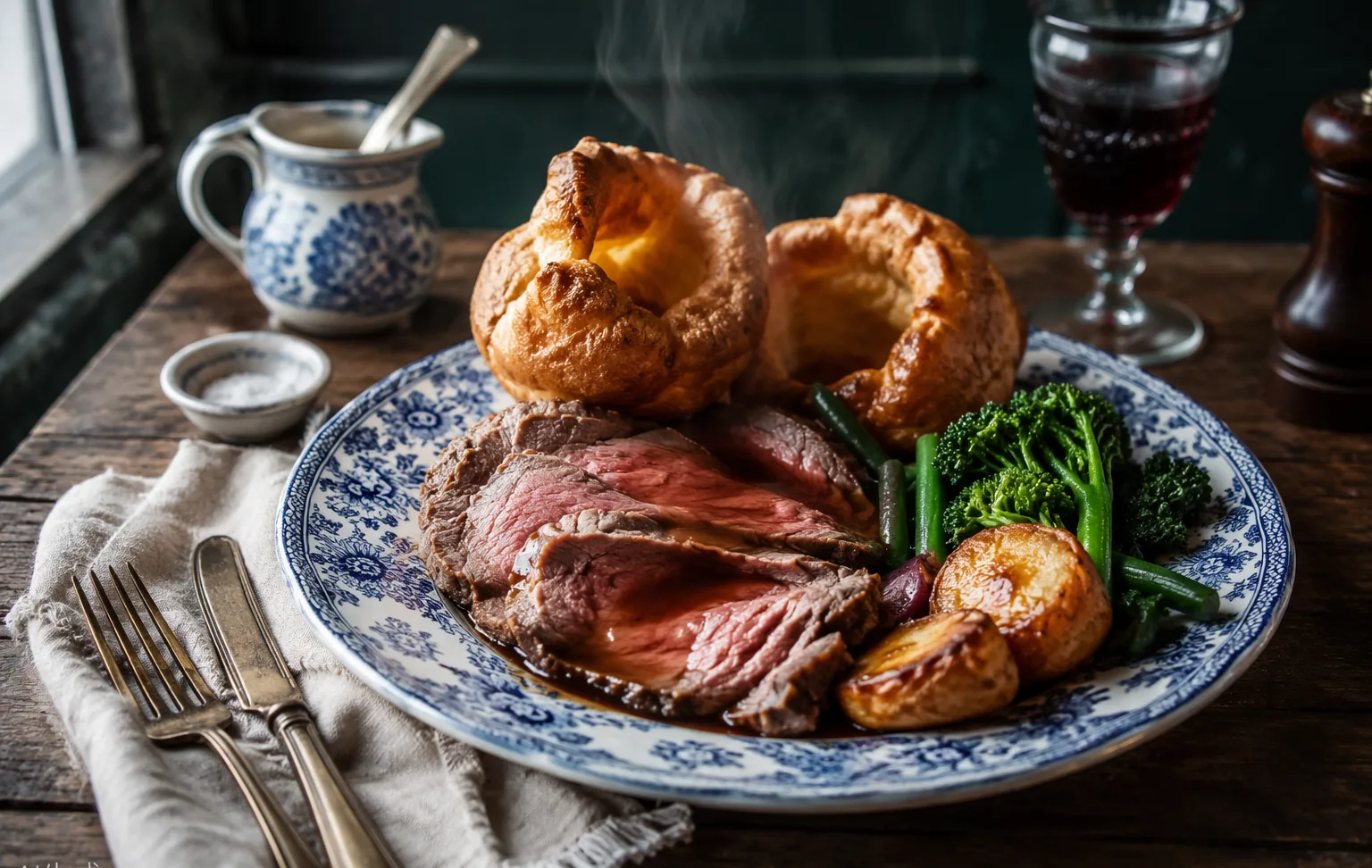
Carve the beef against the grain into 1 cm (½ in) slices. The Yorkshire puddings go out of the oven onto plates immediately — they wait for nothing. The pub way is half the plate beef, one Yorkshire standing like a chimney, gravy poured inside the pud first and over everything after, roast onions alongside, and something green if you must. Horseradish cream is a worthy heresy.
Troubleshooting
| Symptom | Cause | Fix |
|---|---|---|
| Beef grey throughout | Pan and oven not properly hot; or meat carved straight from the oven | Blast stage must sizzle on entry; respect the pull temperatures and the rest |
| Tough, dry slices | Under-rested, carved too thick, or overshot the pull temp | Rest the full 30–40 minutes; carve 1 cm slices against the grain |
| Yorkshires sunken and pale | Fat not shimmering, batter cold, or the door was opened | Fat must just smoke; batter at room temperature; hands off the door until 20 minutes |
| Yorkshires greasy | Too little fat per cup, or oven dropped mid-bake | A full teaspoon of fat per cup, 230 °C throughout |
| Lumpy gravy | Flour added to cold liquid | Cook the flour sandy in the fat first, then add liquid gradually, whisking; strain if needed |
| Gravy tastes thin | Under-seasoned or under-reduced | Simmer to reduce, season last with the resting juices |
Storage, Make-Ahead & Variations
- Batter: up to 24 hours refrigerated, covered — it only improves. - Beef: keeps 4 days refrigerated; slices reheat briefly in hot gravy, or go straight into Monday's sandwich, which is half the reason to roast on Sunday. - Gravy: the base keeps 3 days refrigerated; loosen with stock when reheating. - Leftover roast is a menu: Monday hash, Tuesday pie filling, Wednesday soup. Plan for it. - Toad in the Hole: same batter, sausages browned first in the tin, and the same no-door-opening discipline.